Masdar enters Philippines renewables market

ABU DHABI, 16th January, 2025 (WAM) — Abu Dhabi Future Energy Company PJSC – Masdar has announced its entry into the Philippines market, signing agreements with the government of the Philippines to develop 1 gigawatt (GW) of clean energy projects to strengthen its growing portfolio in Southeast Asia.

The Implementation Agreement with the Department of Energy and the Memorandum of Understanding with the Board of Investments of the Republic of the Philippines covers the development of solar, wind and battery energy storage systems (BESS) with a total capacity of up to 1GW by 2030.

The signing ceremony of both agreements was witnessed by Dr. Sultan Al Jaber, Minister of Industry and Advanced Technology and Chairman of Masdar, and Raphael P.M. Lotilla, Secretary of Energy of the Philippines.

The Implementation Agreement was signed by Undersecretary Dr. Rowena Cristina L. Guevara, Republic of the Philippines Department of Energy, and Masdar’s Chief Executive Officer, Mohamed Jameel Al Ramahi, with the MoU exchanged between the Ambassador of the Philippines to the UAE, Alfonso Ferdinand A. Ver, and Masdar’s CEO.

The agreement, which will support the Philippines Energy Transition Programme to achieve 35 percent renewable energy in power generation by 2030 and 50 percent by 2040, operationalises the MoU on Energy Transition Cooperation signed in November 2024 between the Philippines and the UAE during the working visit of Philippine President Ferdinand R. Marcos Jr. to the country, which identified renewable energy as an area of collaboration.

Dr. Al Jaber said, “This partnership marks a new chapter in the long-standing relationship between the UAE and the Philippines. By leveraging the UAE’s world-class expertise in renewable energy and the Philippines’ abundant natural resources, this agreement will create jobs, drive low-carbon socio-economic progress and expand global renewable energy capacity in line with the UAE Consensus.”

Lotilla commented, “Building on the long-standing ties between our nations and the recent Energy Transition Cooperation agreement, we welcome Masdar’s proven leadership and expertise in delivering utility-scale renewable energy solutions. This collaboration will significantly advance our goal of achieving 35 percent renewable energy in power generation by 2030.”

Secretary Lotilla further emphasised that the landmark partnership underscores the Philippines’ commitment to a clean energy future.

By integrating renewable energy into the country’s energy mix on an unprecedented scale, the Administration of President Marcos Jr. is enhancing energy security while laying a strong foundation for sustainable economic growth and environmental stewardship.

With Masdar’s support, the Philippines is setting a new benchmark for energy transition in the region.

Ceferino S. Rodolfo, Undersecretary at the Philippines Department of Trade and Industry and Board of Investments Managing Head, commented, “It is inspiring to witness the strengthening of the bilateral relations between our countries, following the visit of Philippine President Ferdinand R. Marcos to UAE last year and a series of reciprocal ministerial missions thereafter.

The partnership with Masdar is a testament to our mutual commitment to fostering a dynamic and sustainable economic future, and our shared vision for economic sustainability and prosperity. This aligns seamlessly with the Philippine strategy to position ourselves as a smart and sustainable hub for manufacturing and services in Southeast Asia.”

He added, “The Philippines is making significant strides in the renewable energy sector. Masdar’s own planned renewables projects will contribute to accelerating sustainable economic growth in the different regions in the Philippines, and will especially complement our infrastructure development initiatives within the Luzon Economic Corridor (LEC) — Subic Bay, Clark, Manila, and Batangas — which is being developed as an economic hub for commerce, industry, and logistics.

“The Department of Trade and Industry, through the Board of Investments, will be Masdar’s staunch partner. Together with Masdar, we give our unwavering commitment to fostering a greener and more resilient future for the Philippines.”

Al Ramahi welcomed the announcement as a significant expansion of Masdar’s activities in Southeast Asia, a key strategic market in its ongoing efforts to achieve a renewable energy capacity of 100GW by 2030.

“With our proven success in implementing large-scale renewable energy projects in the region and worldwide, we look forward to utilising our expertise and experience to support the Philippines in meeting its ambitious renewable energy goals,” he added.

The agreement marks Masdar’s entry into the renewables sector in the Philippines. Southeast Asia is a key investment destination for Masdar.

The company has developed the region’s largest floating solar facility in Indonesia – the 145MW Cirata Floating Solar PV plant – which is generating enough electricity to power 50,000 homes.

In February 2023, it entered the geothermal energy sector through a strategic investment in Pertamina Geothermal Energy.

Masdar also signed a landmark agreement with the Malaysian Investment Development Authority in 2023 for the development of 10GW of clean energy projects across the country.

By RM / ES
Read more here

International Day of Clean Energy 26 January

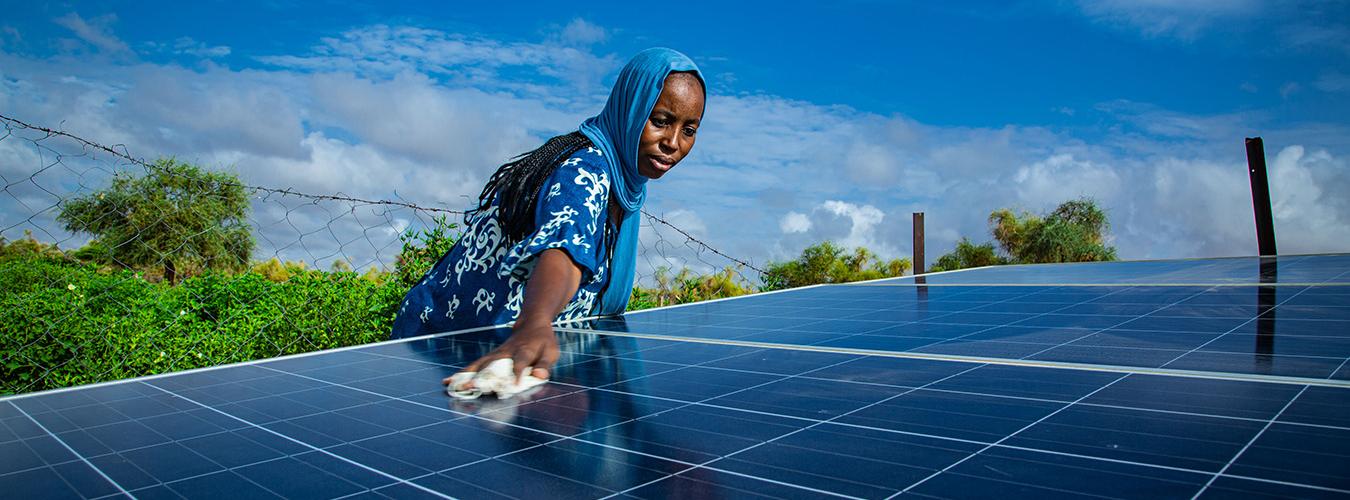
Solar energy is the most abundant of all energy resources and can even be harnessed in cloudy weather.

Photo:Raphael Pouget/UNICEF

Clean energy: for all…
Energy lies at the core of a double challenge: leaving no one behind and protecting the Planet. And clean energy is crucial to its solution.

In a world grappling with climate change, clean energy plays a vital role in reducing emissions, and can also benefit communities lacking access to reliable power sources. Still today, 685 million people live in the dark – more than 80 per cent of them in Sub-Saharan Africa.

The connection between clean energy, socio-economic development, and environmental sustainability is crucial in addressing issues faced by vulnerable communities worldwide.

For populations without clean energy access, the lack of reliable power hinders education, healthcare, and economic opportunities, and many of these developing regions still rely heavily on polluting fossil fuels for their daily life, perpetuating poverty. If current trends continue, by 2030 around 1.8 billion people will still use unsafe, unhealthy and inefficient cooking systems, such as burning wood or dung.

Although this situation has generally been improving, the most recent figures show that the number of people without electricity actually increased by 10 million in 2022, as population growth outpaced progress. The world is not on track to achieve Sustainable Development Goal 7 (SDG7), which aims to ensure access to affordable, reliable, sustainable and modern energy for all by 2030.

… and for our planet
But adopting clean energy is integral to the fight against climate change, as well.

A large chunk of the greenhouse gases that blanket the Earth and trap the Sun’s heat are generated through energy production, by burning fossil fuels (oil, coal, and gas) to generate electricity and heat.

The science is clear: to limit climate change, we need to end our reliance on fossil fuels and invest in alternative sources of energy that are clean, accessible, affordable, sustainable, and reliable. Renewable energy sources – which are available in abundance all around us, provided by the sun, wind, water, waste, and heat from the Earth – are replenished by nature and emit little to no greenhouse gases or pollutants into the air.

At the same time, improving energy efficiency is key. Using less energy for the same output – through more efficient technologies in the transport, building, lighting, and appliances sectors for instance: saves money, cuts down on carbon pollution, and helps ensure universal access to sustainable energy for all.

Background

The International Day of Clean Energy on 26 January was declared by the General Assembly (resolution A/77/327) as a call to raise awareness and mobilize action for a just and inclusive transition to clean energy for the benefit of people and the planet.

26 January is also the founding date of the International Renewable Energy Agency (IRENA), a global intergovernmental agency established in 2009 to support countries in their energy transitions, serve as a platform for international cooperation, and provide data and analyses on clean energy technology, innovation, policy, finance and investment.

Did you know?
Coal, oil, and gas (fossil fuels) are responsible for nearly 90% of global carbon dioxide emissions.
Scientists emphasize the need to cut emissions by almost half by 2030 and achieve net-zero by 2050 to avoid the worst impacts of climate change.
Fossil fuels still dominate global energy production, but renewable sources of energy, such as wind, solar, hydro, and geothermal, now power about 29% of electricity worldwide.


Read more here: https://www.un.org/en/observances/clean-energy-d


UN DESA Voice January 2025: Milestone events to advance sustainable development

MONTHLY NEWSLETTER, VOL 29, NO. 1 – JANUARY 2025

3 milestone moments in 2025 to shape our sustainable future

While we’ve just counted down to a new year, another clock continues to tick: for the 2030 Agenda and its Sustainable Development Goals. In 2025 – the 80th anniversary of the United Nations – UN DESA will continue accelerating progress by bringing the international community together, by building capacity on the ground and by providing essential data through our flagship publications. Here are some milestone moments to follow in 2025.

Read more 

EXPERT VOICES


Behind the numbers of a new report on the global economy

On 9 January, UN DESA will release the 2025 World Economic Situation and Prospects (WESP) report, presenting the latest forecast for the global economy. What makes this edition different from other reports covering the global economy and what can we expect from it this year? We spoke with Katarzyna Rokosz and Zhenqian Huang – members of the WESP team – to find out.

Read more here:

THINGS YOU NEED TO KNOW

Things you should know about global efforts towards a clean energy transition

Clean energy is crucial for reaching net zero emissions by 2050 and protecting the climate and our natural world. A just and inclusive energy transition is key to limiting global heating to 1.5 degrees Celsius and preventing the worst climate impacts. Clean and affordable energy for everyone – Sustainable Development Goal (SDG) 7 – is also critical in reducing poverty, improving health, education and gender equality, and creating sustainable jobs and economic growth. Here are three things to know about the clean energy transition.

Read more here:

MORE FROM UN DESA

UN ECOSOC: The way forward
Experts unite to accelerate gender equality

Read more here: https://desapublications.un.org/un-desa-voice/january-2025