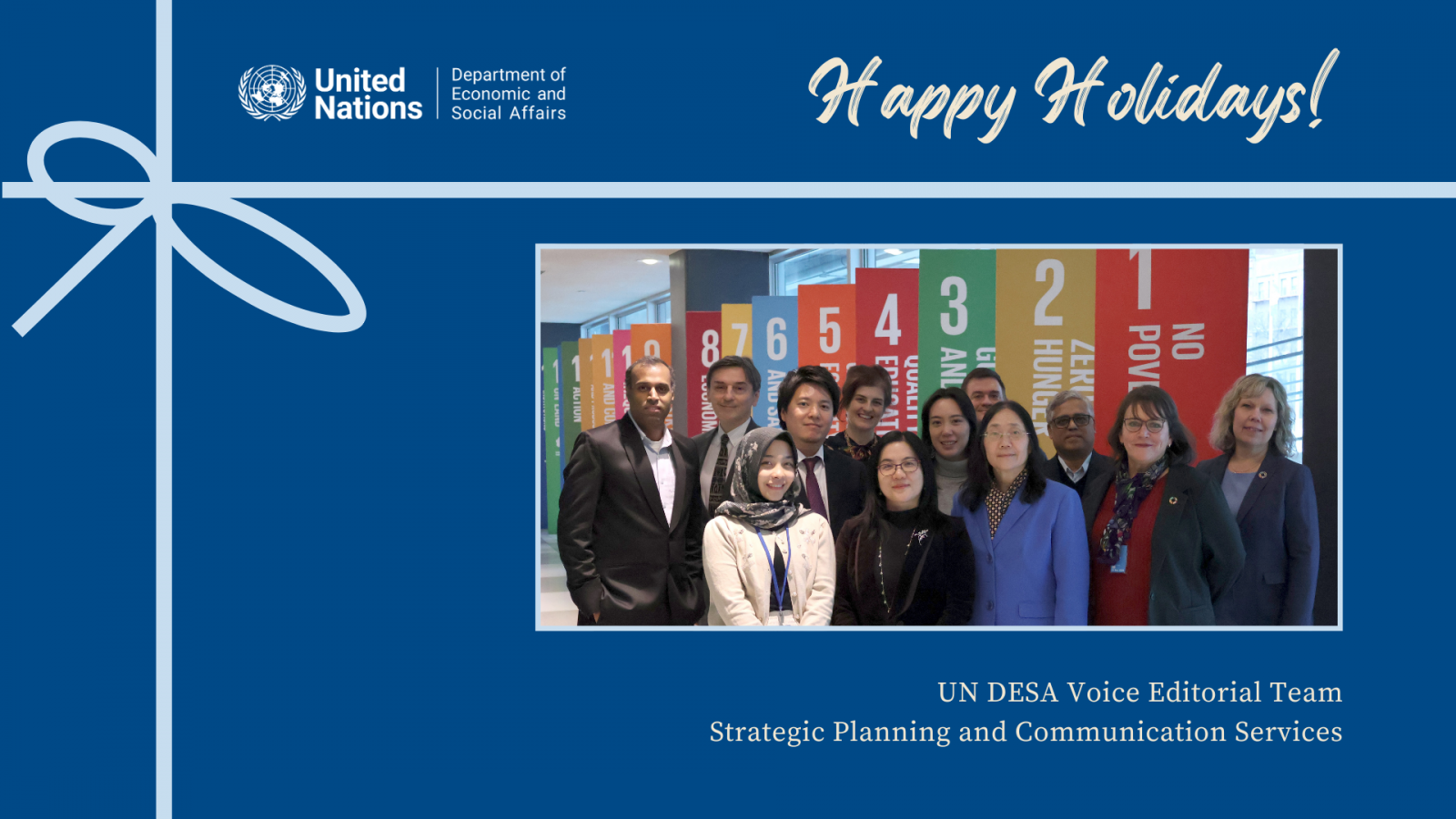
Happy Holidays from UN DESA!


Dear UN DESA Voice Readers,

We hope that this message finds you and your loved ones safe and well.

As 2025 draws to a close, we reflect on a year marked by turbulence and interconnected crises impacting communities worldwide.

Through these challenges, UN DESA has continued to work with determination and resolve to keep the promise of the Sustainable Development Goals (SDGs) alive.

With the 2030 deadline fast approaching, UN DESA has led efforts to support an unprecedented series of high-level conferences and events this year, including the UN Ocean Conference, the Internet Governance Forum, the Fourth International Conference on Financing for Development, the High-level Political Forum on Sustainable Development and the Second World Summit for Social Development, among others.

Our commitment to ensure that climate and SDG action are fully aligned also remains strong. Our SDG Pavilion at COP continues to serve as a hub for hope and action, advancing efforts to combat climate change while advancing the SDGs. If you missed some of the sessions at the SDG Pavilion at COP30, recordings are available on UN DESA’s YouTube channel.

Throughout the year, we have shared data, analysis, and policy advice with a global audience through the Global Policy Dialogue Series and our UN DESA Policy Briefs, addressing some of the most pressing issues facing policymakers worldwide. You can explore UN DESA’s latest publications on our website.

Looking forward to 2026, UN DESA will continue to support Member States – through ECOSOC and its functional commissions and advisory bodies, the High-level Political Forum and the Second and Third Committees of the General Assembly – in forging a just, inclusive, and sustainable future for all.

To learn more about UN DESA’s efforts, we invite you to read UN DESA’s Annual Highlights Report 2025. You can also follow UN DESA’s Under-Secretary-General Li Junhua on LinkedIn, for insights on sustainable development, international cooperation, and a behind-the-scenes perspective on major events.

As Mr. Li noted upon joining LinkedIn in May:

“At the United Nations, we represent diverse voices connected by a shared purpose: building a more inclusive, equitable and sustainable world. I’m glad to join LinkedIn and engage with this vibrant community and look forward to rich and scholarly discussions on the most pressing global challenges of our time”.

As this year comes full circle, we extend our heartfelt thanks for your continued readership and support of UN DESA’s work. We are honored to have you with us on this journey toward sustainable development for all.

We wish you all Happy Holidays and a Happy New Year! Stay well and safe!

With best regards,
The UN DESA Voice Editorial Team

UN DESA Voice December 2025: Latest urbanization trends reveal top megacities

Latest urbanization data reveal world’s most populous cities

Our world is becoming increasingly urban. Cities are now home to 45 per cent of the global population of 8.2 billion, according to UN DESA’s World Urbanization Prospects 2025: Summary of Results, released on 18 November 2025.

The number of people living in cities has more than doubled since 1950, when only 20 per cent of the world’s 2.5 billion people lived in cities. Looking ahead through 2050, two-thirds of global population growth is projected to occur in cities, and most of the remaining one-third in towns.

The number of megacities, urban areas with 10 million or more inhabitants, has quadrupled from 8 in 1975 to 33 in 2025. Over half of these (19) are in Asia.

Jakarta (Indonesia) is now the world’s most populous city, with nearly 42 million residents, followed by Dhaka (Bangladesh) with almost 40 million, and Tokyo (Japan) with 33 million. Cairo (Egypt) is the only non-Asian city among the top ten. By 2050, the number of megacities is expected to rise to 37, with cities such as Addis Ababa (Ethiopia), Dar es Salaam (United Republic of Tanzania), Hajipur (India), and Kuala Lumpur (Malaysia) projected to surpass the 10 million mark.

Despite the prominence of megacities, the report finds that small and medium-sized cities are home to more people than megacities and are growing at a faster pace, particularly in Africa and Asia. The report also highlights the divergent growth patterns of cities. While many cities continue to expand, others are experiencing population decline.

Towns, defined as population clusters of at least 5,000 inhabitants and a density of at least 300 people per square kilometer, are the most common settlement type in 71 countries as diverse as Germany, India, Uganda, and the United States. They play a vital role in connecting rural areas and cities, offering essential services and supporting local economies. Rural areas on the other hand, remain the most common settlement type in 62 countries today, down from 116 in 1975. By 2050, this number is projected to decline further to 44 countries. Sub-Saharan Africa is the only region where rural populations have continued to grow significantly, and the region is expected to account for nearly all future rural population growth.

“Sustainable development depends on seeing cities, towns and rural areas as one interconnected system. We need to proactively plan to develop different areas evenly and ease pressure on large cities,” said UN DESA’s Assistant Secretary-General for Policy Coordination Bjørg Sandkjær.

“The World Urbanization Prospects report gives us the data and insights we need to plan for that shared future,” Ms. Sandkjær said, referring to the report’s role in providing a critical evidence base for policymakers, planners, and researchers working to shape sustainable, inclusive, and resilient urban futures.

The 2025 edition also introduces major methodological innovations. For the first time, it integrates the Degree of Urbanization, a harmonized geospatial approach that provides projections for three categories of settlements: cities, towns, and rural areas. This new approach enhances international comparability and offers a more nuanced understanding of urbanization trends.

All materials related to the World Urbanization Prospects 2025, including the summary report and the complete dataset, are available at population.un.org.

Expert Voices

Disability advocates drive change through the Doha Declaration

The Second World Summit for Social Development which concluded last month in Doha, was designed with inclusion at its core. Ahead of the International Day of Persons with Disabilities on 3 December, the team in UN DESA’s Division for Inclusive Social Development, shared how the Social Summit helped advance the rights of persons with disabilities.

What does the Doha Political Declaration mean for persons with disabilities?

“The Doha Political Declaration, adopted at the Second World Summit for Social Development, reinforces that social development cannot be achieved unless persons with disabilities enjoy their full rights, participate meaningfully in decision-making, and have equitable access to opportunities. For persons with disabilities, the Declaration represents a renewed global consensus that their inclusion is integral to poverty eradication, decent work for all, and social integration.

It affirms the commitment of Member States to implement disability-inclusive, accessible and rights-based policies, and ensure accessible services, technologies, and environments, in accordance with the Convention on the Rights of Persons with Disabilities. Most importantly, the Declaration emphasizes measurable action, shifting from broad aspiration to concrete commitments that improve everyday lives. For instance, the Declaration calls for social protection schemes that are equally accessible for persons with disabilities and that address additional disability-related costs, like costs of assistive technology or health care, that often push persons with disabilities into poverty.”

How were persons with disabilities placed at the centre of determining their rights and future?

“The Summit was designed with inclusion at its core.

On the substantive side, persons with disabilities participated in the lead-up to the Summit and across the official and parallel programme, ensuring that disability-inclusive development is treated not as a standalone issue, but as a cross-cutting priority for all social development efforts. Organizations representing persons with disabilities were actively involved in shaping solutions, spotlighting barriers, and proposing innovations.

On the operational side, accessibility was mainstreamed throughout the Summit: international sign language interpretation, closed captioning, and accessible communication ensured that persons with disabilities could follow and contribute to the dialogue.”

What will be the focus of this year’s International Day of Persons with Disabilities?

“This year’s International Day of Persons with Disabilities will focus on “Fostering disability-inclusive societies for advancing social progress.” The theme reflects the vision of the Doha Political Declaration and builds on the momentum generated by the Second World Summit for Social Development.

The commemoration will highlight how disability inclusion is essential to achieving the Summit’s core objectives, poverty eradication, decent work for all, and social integration, and will discuss next steps and urgent actions needed to implement the Summit’s commitments and achieve disability inclusive development.

For more information: International Day of Persons with Disabilities (IDPD)

Things You Need To Know

7 things you need to know about sustainable transportation

Sustainable transport is about cleaner mobility and safer systems; extending markets; shaping access to jobs, schools and health care; and enabling the movement of food and medicines. With transport demand set to more than double by 2050, choices we make this decade, can unlock sustainable development pathways. Here are 7 things you need to know.

1. Transport can be a climate solution. Transport generates a quarter of all energy-related emissions and relies on fossil fuels for 95 per cent of its energy. Shifting to public transport, walking, cycling and low- and zero-emission vehicles can cut emissions and improve health.

2. A billion people remain without access. One-third of the global rural population live more than 2 km from an all-season road – nearly half of them in Africa. Without reliable transport, farmers, patients and students cannot reach markets, clinics or schools.

3. Safe system design saves lives. Road crashes are the leading cause of death for ages 5 to 29, and kill 1.2 million people every year, 92 per cent in low- and middle-income countries. Safe system design, including speed management and protected walking and cycling, could save millions of lives.

4. Smart investment is key. Achieving sustainable transport requires smart investments. Redirecting existing spending, reforming fossil-fuel subsidies and using tools like green bonds and fair user charges can finance more sustainable, safer and more inclusive mobility.

5. Cities will decide our future. By 2050, 70 per cent of people and 85 per cent of economic output will be urban. Urban planning aligned with sustainable transport could cut congestion, CO₂ emissions and pollution while improving health, prosperity, equity and quality of life.

6. The UN Decade of Sustainable Transport (2026–2035) will accelerate improvements. Its Implementation Plan provides a roadmap to align policies, finance, technology and data enabling transport to advance all 17 Sustainable Development Goals. The Decade’s launch on 10 December 2025 will invite governments, cities, business, civil society and youth to commit to progress together.

7. Actions you can take. Engage with the UN Decade of Sustainable Transport in your country or city; choose public transport, walking and cycling; and encourage your institution to align its actions with the Implementation Plan.

For more information: UN Decade of Sustainable Transport.

GIF

SDG blog

SDG

Read more here: https://un.mdrtor.com/track/display/empId/117142/subId/140/listId/1/conId/63744/signature/aefe1ebdd6b10d0378bae8f8c0adf86d/conEmail/[email protected]/conMovil/-/snapId/114476

IRENA at COP30: as COP30 ends, countries focus on implementation

COP30 WRAP UP

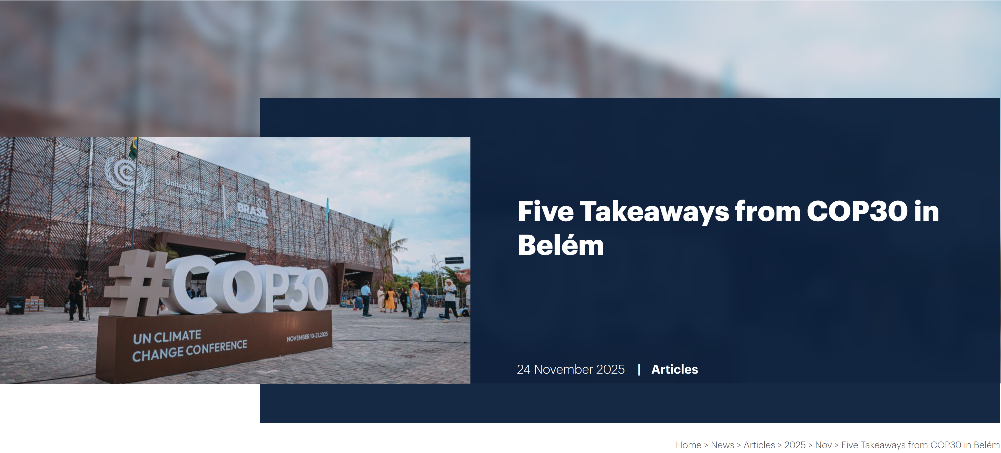
The 30th United Nations Climate Change Conference (COP30), which concluded last week, signaled a global shift toward implementation. Together with global partners and allies, IRENA demonstrated how commitments can be translated into concrete action on the ground, with the goal of catalysing just and inclusive energy transitions by raising ambition and scaling up investments.

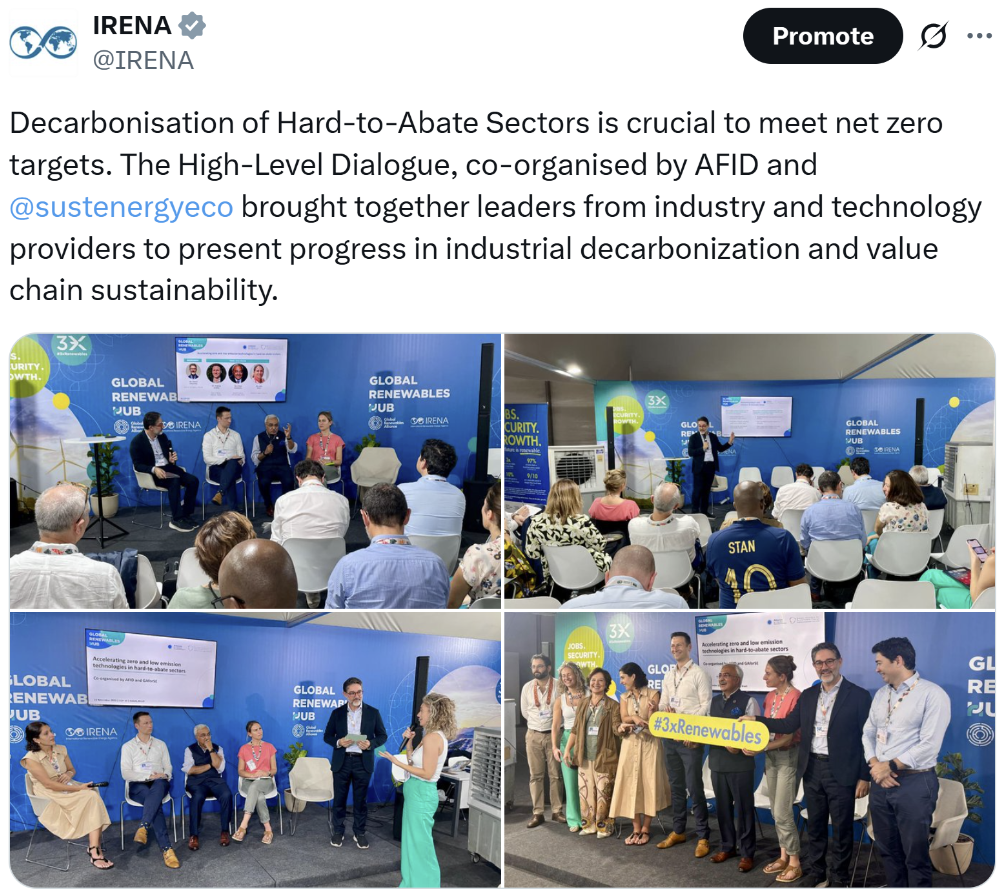
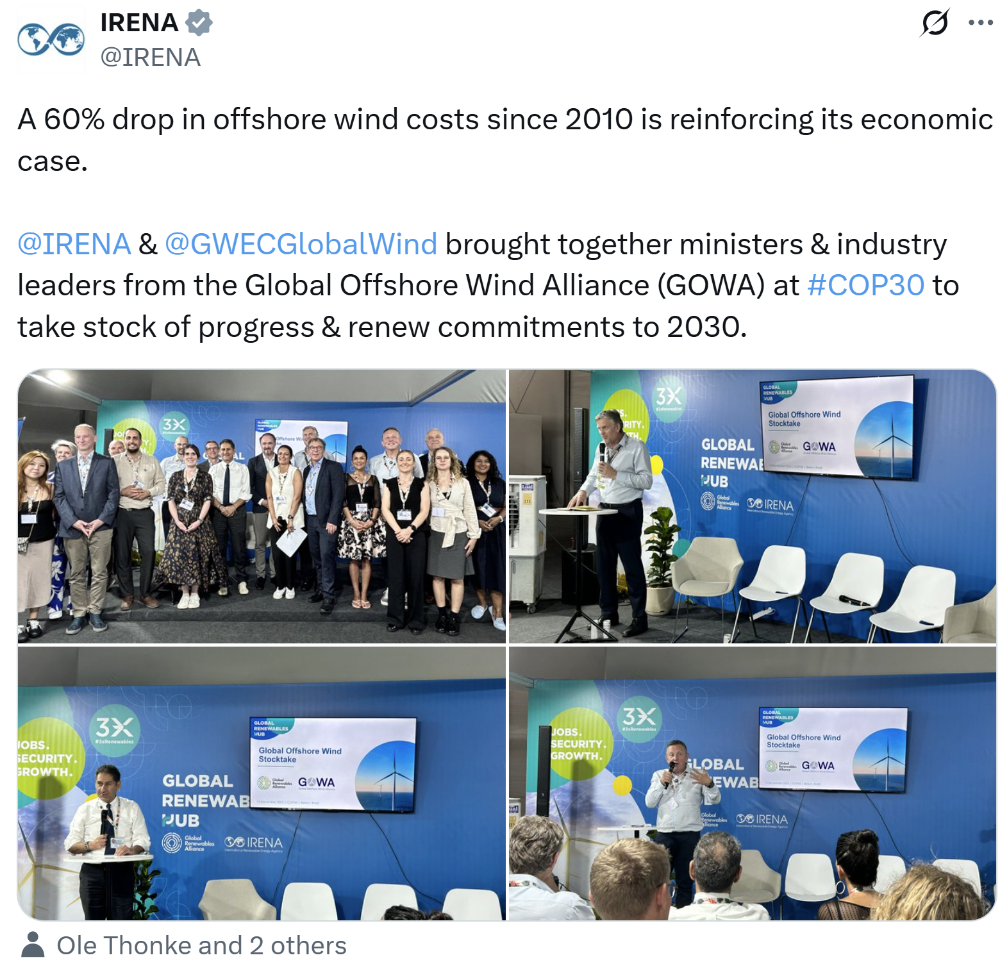
IRENA’s pavilion, the Global Renewables Hub jointly hosted with the Global Renewables Alliance (GRA), provided a lively platform for engaging exchanges with IRENA Members, partners and guests.

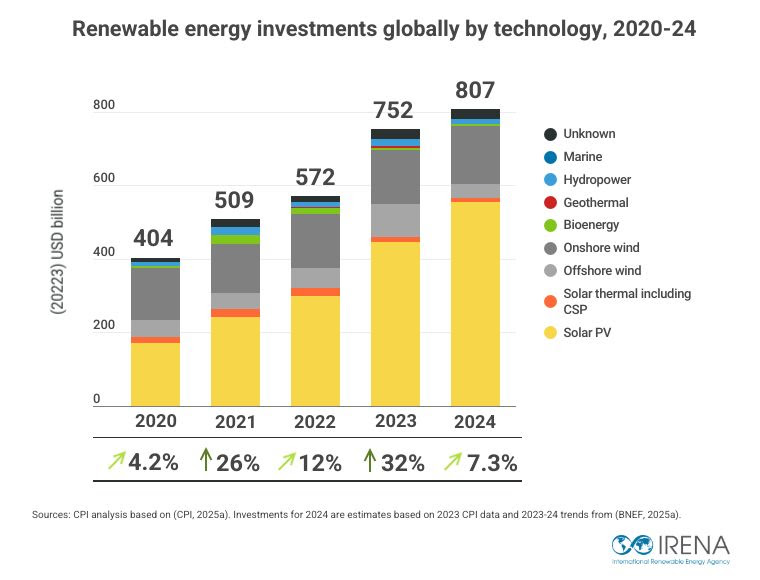
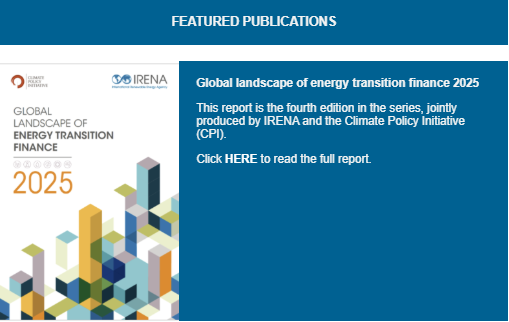
Released to inform the global finance discourse, Global Landscape of Energy Transition Finance 2025 revealed a new record of USD 2.4 trillion in energy transition investments in 2024, but these were highly concentrated in advanced economies, leaving emerging and developing countries behind.

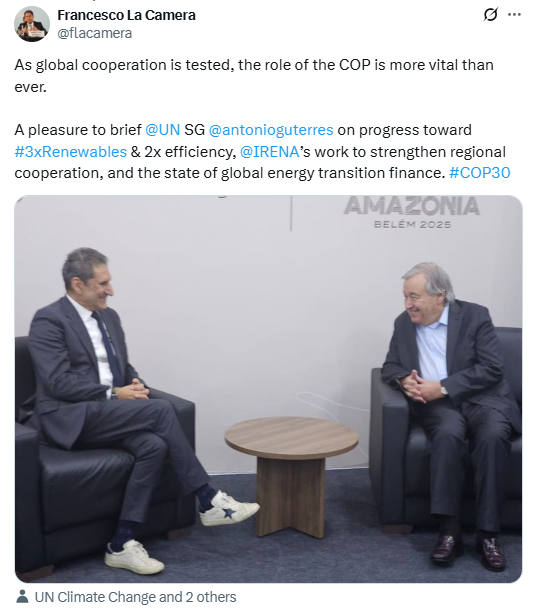
In a bilateral meeting with UN Secretary-General António Guterres, IRENA Director-General Francesco La Camera briefed him on progress towards the UAE Consensus goals to triple renewable capacity and double energy efficiency by 2030, and reaffirmed the Agency’s commitment to strengthening regional cooperation and boosting energy transition finance.

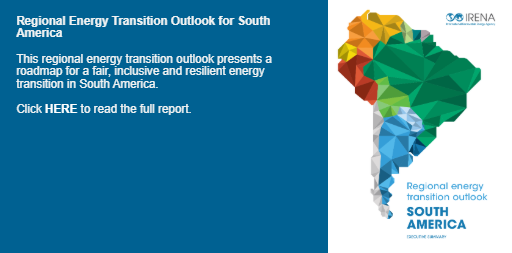
Launched at COP30, IRENA’s new Regional Energy Transition Outlook South America highlights the vast opportunities for economic growth, innovation, and energy security across the region through cooperation and the scale of investment. The region could significantly grow its GDP while creating more than 12 million jobs in the energy sector by 2050.

As a group of the world’s leading power utilities, the Utilities for Net Zero Alliance (UNEZA), facilitated by IRENA, aims to address key investment barriers, particularly in grids and flexibility. At COP30, UNEZA announced increased investment commitments of nearly USD 150 billion annually, with a major focus on grid infrastructure.

For more on the COP30 takeaway and IRENA’s insights on ways forward, please read this article. Please also see below IRENA’s latest data and activities in support of the climate objectives discussed at COP30.

Read more here: https://www.irena.org/Events/2025/Nov/IRENA-at-COP30

ADB under fire for ‘false solutions’ in energy policy review

By: Cristina Eloisa Baclig – Content Researcher Writer / @inquirerdotnetINQUIRER.net
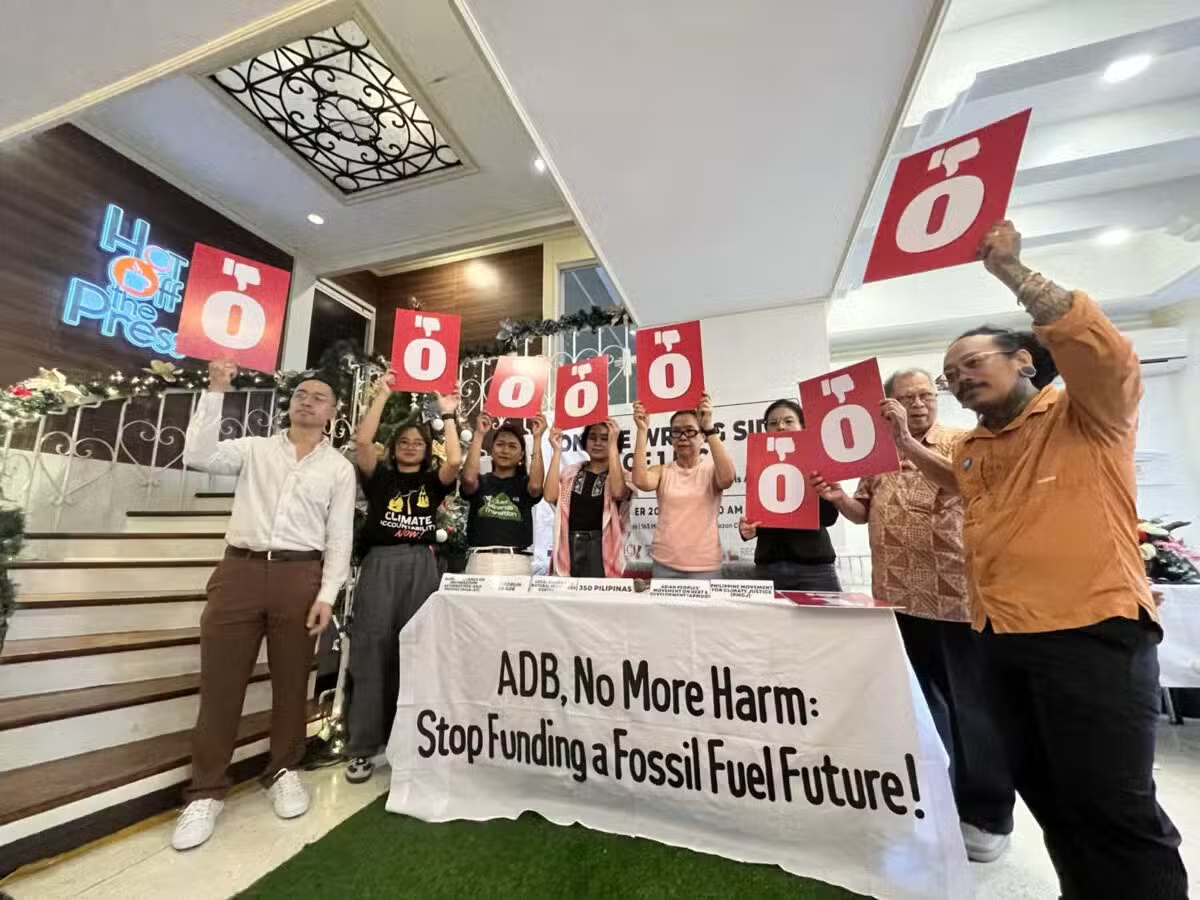
Civil society leaders give Asian Development Bank a “zero” on climate action during a press briefing in Quezon City on November 20, 2025, calling on the bank to stop funding fossil fuels and commit fully to a just energy transition.

(Photo from GAIA Asia Pacific)

MANILA, Philippines — Civil society groups on Thursday slammed the Asian Development Bank (ADB) for what they called a “dangerous pivot” toward corporate interests and false climate solutions, as the bank reviews its 2025 energy policy and faces scrutiny over decades of support for incineration and fossil fuels.

In separate statements released on November 20, the Global Alliance for Incinerator Alternatives (GAIA) Asia Pacific and the NGO Forum on ADB scored the multilateral lender for continued financing of polluting waste-to-energy (WtE) incineration and fossil gas infrastructure.

Both groups argue that the Bank’s draft policy fails to adequately protect climate-vulnerable communities, disregards human rights safeguards, and undermines global climate goals.

Billions in incineration financing since Paris Agreement
GAIA, a global alliance of over 1,000 grassroots groups and organizations in 90 countries, warned that ADB remains the region’s top backer of incineration-based waste management.

Since the Paris Agreement in 2015, GAIA noted that the Bank has financed 49 projects with incineration or co-incineration components amounting to USD 15.3 billion. Meanwhile, a separate analysis by the Climate Policy Initiative found that over 94 percent of climate finance intended for methane abatement in the waste sector continues to go to incineration.

“This reflects a troubling pattern,” GAIA said. “Money intended for climate action is being diverted to technologies that worsen pollution and drain public resources.”

GAIA’s Climate and Anti-Incineration Campaigner Brex Arevalo emphasized that incinerators—regardless of technology—continue to pollute and create hazardous byproducts.

“Incinerators remain polluters no matter the technology,” Arevalo said. “While incineration reduces waste volume, the remaining ash, wastewater, and emissions are hazardous and must still be disposed of in landfills. This exposes the myth that incineration eliminates the need for dumpsites. It does not. It creates even more toxic byproducts.”

Communities in debt, distress, and danger
GAIA and its regional partners stated that ADB-backed incineration projects are exacerbating economic and environmental risks for vulnerable countries.

In the Maldives, Zero Waste Maldives’ Afrah Ismail warned that the Bank is pushing a massive WtE incinerator in Thilafushi, despite the archipelago’s high debt burden and climate vulnerability.

“ADB has backed waste-to-energy incineration through loans and grants for a major WtE plant in the Maldives, a climate-vulnerable archipelago whose public debt now exceeds 120% of GDP and which international financial institutions classify as being at high risk of debt distress,” Ismail said.

Chythenyen Kulasekaran of the Centre for Financial Accountability cited India’s experience as further proof of failure.

“The ADB should not be funding waste-to-energy incineration, which has a massive track record of failure across South Asia. All 21 waste-to-energy plants in India are highly polluting and do not comply with the environmental policy standards, as reported by the government itself.”

‘Zero marks across the board’
In a separate assessment, the NGO Forum on ADB—a network of civil society groups monitoring the Bank and the Asian Infrastructure Investment Bank—gave the ADB a failing grade on climate, human rights, and transparency.

Citing the 2025 Energy Policy Review and draft amendments, the Forum warned that the Bank continues to support the expansion of fossil fuels and extractive industries, while ignoring demands for genuine stakeholder consultation.

“The Bank’s process violated its own Access to Information Policy and commitments to stakeholder engagement,” the group said. “Key documents were disclosed late, consultations were brief and selective, and feedback was not meaningfully integrated.”

The draft policy retains fossil gas as a so-called “transition fuel,” allowing continued investment in gas pipelines and exploration, despite what the Forum calls “overwhelming scientific consensus” that no new oil or gas fields are compatible with limiting global warming to 1.5°C.

The Forum also raised concerns over the ADB’s Energy Transition Mechanism (ETM), which critics argue may prolong fossil fuel use rather than accelerate coal retirement. Loopholes in ADB’s coal ban remain, it added, and mining is now being rebranded as “green” through the Bank’s Critical Minerals for Clean Energy Technologies (CM2CET) initiative.

ADB is also reportedly considering lifting its nuclear energy financing ban.

“This is a reckless regression,” the Forum said. “Nuclear remains expensive, unsafe, and produces long-lived radioactive waste, while Small Modular Reactors are unproven and financially burdensome.”

Other so-called “false solutions” identified in the revised policy include coal co-firing, large hydropower, waste-to-energy, and geothermal projects sited in Indigenous territories—all of which, the Forum said, come with risks of displacement, repression, land conflicts, and gendered harm.

“Energy transitions that violate rights are neither just nor sustainable,” the coalition added. “ADB’s silence speaks louder than its rhetoric.”

Civil society demands
Over a hundred civil society organizations endorsed the Forum’s Climate Scorecard, which uses lived experience as its grading system: “gas pipelines through Indigenous lands—zero; opaque financial intermediary lending that hides coal exposure—zero; promotion of nuclear, extractives, and incinerators while claiming climate leadership—zero.”

“ADB’s score of zero is a mirror reflecting the Bank’s own choices,” the coalition said.

They are now calling on the ADB Board of Directors to reject the draft energy policy in its current form and implement urgent reforms. These include:

A fully transparent review process through 2026
Closure of all coal financing loopholes
A time-bound fossil gas phaseout
Rejection of nuclear energy and CM2CET extractive-driven initiatives
An end to all false solutions
Binding human rights and just transition standards
Full alignment with the 1.5°C climate goal and a complete fossil fuel phaseout by 2030
“ADB’s Energy Policy Review remains a failed test and a failing grade,” the Forum concluded. “The climate emergency demands leadership rooted in justice and science — not profit, not technofixes, and not exclusion. Communities across Asia refuse to accept another generation locked into fossil fuels.”

Read more here: ADB under fire for ‘false solutions’ in energy policy review