By: Cristina Eloisa Baclig – Content Researcher Writer / @inquirerdotnetINQUIRER.net
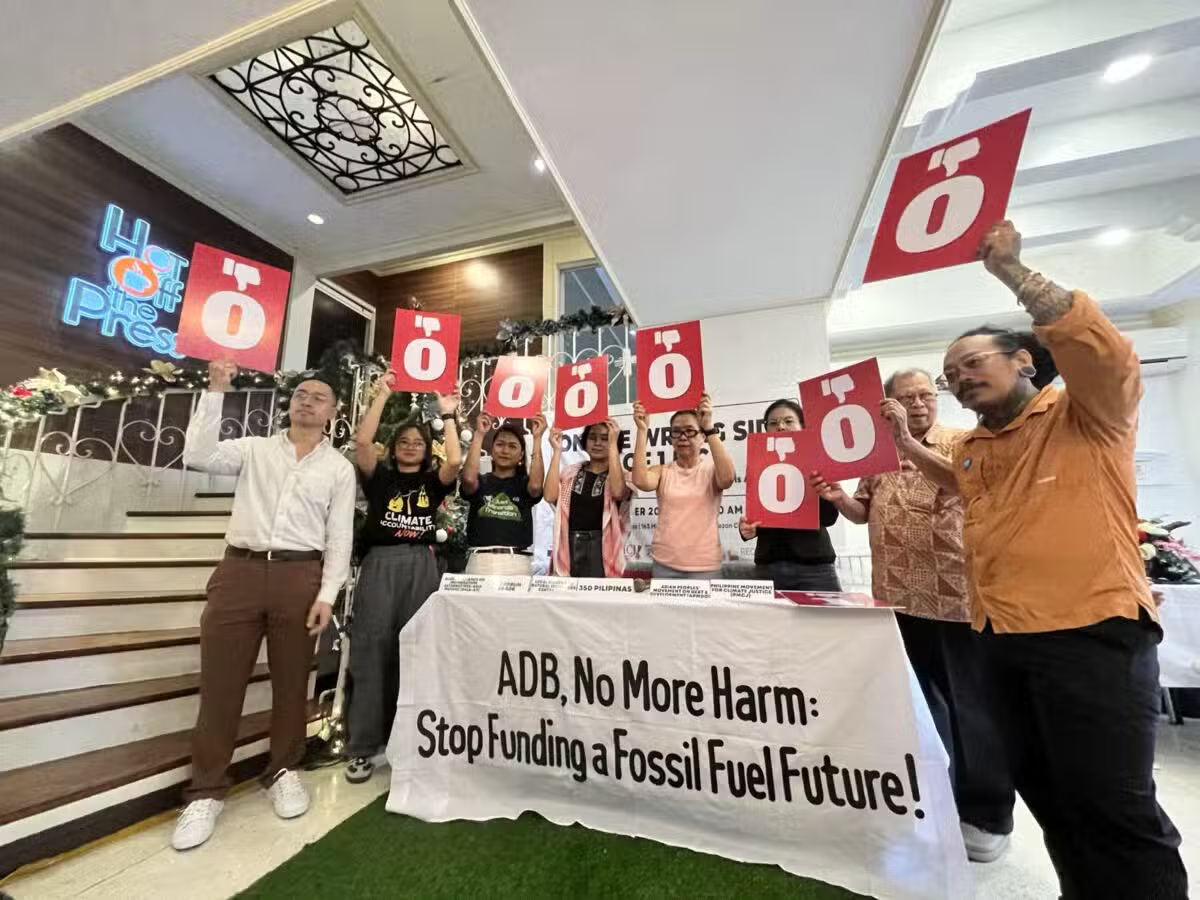
Civil society leaders give Asian Development Bank a “zero” on climate action during a press briefing in Quezon City on November 20, 2025, calling on the bank to stop funding fossil fuels and commit fully to a just energy transition.
(Photo from GAIA Asia Pacific)
MANILA, Philippines — Civil society groups on Thursday slammed the Asian Development Bank (ADB) for what they called a “dangerous pivot” toward corporate interests and false climate solutions, as the bank reviews its 2025 energy policy and faces scrutiny over decades of support for incineration and fossil fuels.
In separate statements released on November 20, the Global Alliance for Incinerator Alternatives (GAIA) Asia Pacific and the NGO Forum on ADB scored the multilateral lender for continued financing of polluting waste-to-energy (WtE) incineration and fossil gas infrastructure.
Both groups argue that the Bank’s draft policy fails to adequately protect climate-vulnerable communities, disregards human rights safeguards, and undermines global climate goals.
Billions in incineration financing since Paris Agreement
GAIA, a global alliance of over 1,000 grassroots groups and organizations in 90 countries, warned that ADB remains the region’s top backer of incineration-based waste management.
Since the Paris Agreement in 2015, GAIA noted that the Bank has financed 49 projects with incineration or co-incineration components amounting to USD 15.3 billion. Meanwhile, a separate analysis by the Climate Policy Initiative found that over 94 percent of climate finance intended for methane abatement in the waste sector continues to go to incineration.
“This reflects a troubling pattern,” GAIA said. “Money intended for climate action is being diverted to technologies that worsen pollution and drain public resources.”
GAIA’s Climate and Anti-Incineration Campaigner Brex Arevalo emphasized that incinerators—regardless of technology—continue to pollute and create hazardous byproducts.
“Incinerators remain polluters no matter the technology,” Arevalo said. “While incineration reduces waste volume, the remaining ash, wastewater, and emissions are hazardous and must still be disposed of in landfills. This exposes the myth that incineration eliminates the need for dumpsites. It does not. It creates even more toxic byproducts.”
Communities in debt, distress, and danger
GAIA and its regional partners stated that ADB-backed incineration projects are exacerbating economic and environmental risks for vulnerable countries.
In the Maldives, Zero Waste Maldives’ Afrah Ismail warned that the Bank is pushing a massive WtE incinerator in Thilafushi, despite the archipelago’s high debt burden and climate vulnerability.
“ADB has backed waste-to-energy incineration through loans and grants for a major WtE plant in the Maldives, a climate-vulnerable archipelago whose public debt now exceeds 120% of GDP and which international financial institutions classify as being at high risk of debt distress,” Ismail said.
Chythenyen Kulasekaran of the Centre for Financial Accountability cited India’s experience as further proof of failure.
“The ADB should not be funding waste-to-energy incineration, which has a massive track record of failure across South Asia. All 21 waste-to-energy plants in India are highly polluting and do not comply with the environmental policy standards, as reported by the government itself.”
‘Zero marks across the board’
In a separate assessment, the NGO Forum on ADB—a network of civil society groups monitoring the Bank and the Asian Infrastructure Investment Bank—gave the ADB a failing grade on climate, human rights, and transparency.
Citing the 2025 Energy Policy Review and draft amendments, the Forum warned that the Bank continues to support the expansion of fossil fuels and extractive industries, while ignoring demands for genuine stakeholder consultation.
“The Bank’s process violated its own Access to Information Policy and commitments to stakeholder engagement,” the group said. “Key documents were disclosed late, consultations were brief and selective, and feedback was not meaningfully integrated.”
The draft policy retains fossil gas as a so-called “transition fuel,” allowing continued investment in gas pipelines and exploration, despite what the Forum calls “overwhelming scientific consensus” that no new oil or gas fields are compatible with limiting global warming to 1.5°C.
The Forum also raised concerns over the ADB’s Energy Transition Mechanism (ETM), which critics argue may prolong fossil fuel use rather than accelerate coal retirement. Loopholes in ADB’s coal ban remain, it added, and mining is now being rebranded as “green” through the Bank’s Critical Minerals for Clean Energy Technologies (CM2CET) initiative.
ADB is also reportedly considering lifting its nuclear energy financing ban.
“This is a reckless regression,” the Forum said. “Nuclear remains expensive, unsafe, and produces long-lived radioactive waste, while Small Modular Reactors are unproven and financially burdensome.”
Other so-called “false solutions” identified in the revised policy include coal co-firing, large hydropower, waste-to-energy, and geothermal projects sited in Indigenous territories—all of which, the Forum said, come with risks of displacement, repression, land conflicts, and gendered harm.
“Energy transitions that violate rights are neither just nor sustainable,” the coalition added. “ADB’s silence speaks louder than its rhetoric.”
Civil society demands
Over a hundred civil society organizations endorsed the Forum’s Climate Scorecard, which uses lived experience as its grading system: “gas pipelines through Indigenous lands—zero; opaque financial intermediary lending that hides coal exposure—zero; promotion of nuclear, extractives, and incinerators while claiming climate leadership—zero.”
“ADB’s score of zero is a mirror reflecting the Bank’s own choices,” the coalition said.
They are now calling on the ADB Board of Directors to reject the draft energy policy in its current form and implement urgent reforms. These include:
A fully transparent review process through 2026
Closure of all coal financing loopholes
A time-bound fossil gas phaseout
Rejection of nuclear energy and CM2CET extractive-driven initiatives
An end to all false solutions
Binding human rights and just transition standards
Full alignment with the 1.5°C climate goal and a complete fossil fuel phaseout by 2030
“ADB’s Energy Policy Review remains a failed test and a failing grade,” the Forum concluded. “The climate emergency demands leadership rooted in justice and science — not profit, not technofixes, and not exclusion. Communities across Asia refuse to accept another generation locked into fossil fuels.”
Read more here: ADB under fire for ‘false solutions’ in energy policy review

 Photo c/o Presidential Communications Office
  Photo c/o Presidential Communications Office
 Photo c/o Presidential Communications Office
  Photo c/o Presidential Communications Office
  Photo c/o Presidential Communications Office
  Photo c/o Presidential Communications Office